Sawdust Beats Steel: The Case for Leaving the Axe at Home

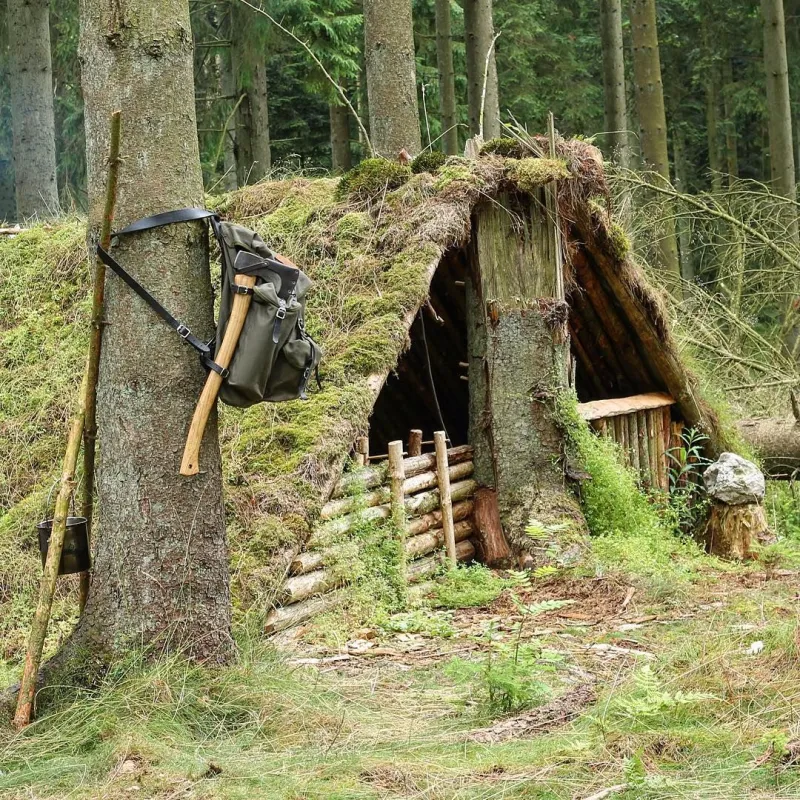
Photo: StromBer, CC BY-SA 2.0 de, via Wikimedia Commons
There is a photograph that sells a thousand axes. A bearded figure in a wool shirt, feet planted, steel biting into a round of timber, chips flying. It is a good photograph. It is also, for most of us in most British woods, a piece of theatre.
The folding saw is the tool that actually gets used. It lives in a side pocket, weighs about as much as a flask, and cuts the sort of wood you find in a British wood on a British weekend. If you are packing an axe for a two-night camp in a Sussex or Perthshire wood, this is me politely asking what you think you are going to chop.
The axe is a beautiful answer to a question we are not asking
British woodland is small, mixed and frequently wet. It is often protected, always someone's responsibility, and rarely full of the straight, clean, seasoned rounds that axe work assumes. What you find is deadfall: ash branches, birch limbs, willow, the odd fallen conifer. Most of it is under ten centimetres across.
You do not need a swing and a chopping block for a wrist-thick branch. You need a saw, two minutes, and a bit of patience.
What a folding saw actually delivers
A decent folding saw — the sort with a 240mm blade and a decent tooth pattern — cuts green or dead wood quickly and cleanly. One-handed, on the pull stroke, with no arc to control and no clear zone to police. It folds into a pocket. Blades are replaceable. It is cheap enough that you will not baby it.
It also crosscuts. That sounds obvious, but it is the job you will do most: shortening deadwood into stove lengths, trimming a pole for a tarp, taking the end off a branch so it fits the fire. A saw does that better than an axe, and it does it without sending splinters into your eye.
The safety maths is not close
Axe injuries tend to be dramatic. A glancing blow, a wet handle, cold hands, fatigue at the end of a long day — and the blade finds a shin or a hand. Most of that risk is manageable with training, a chopping block and a clear head. But it is still risk you are choosing to carry.
A saw cuts on the pull stroke, with the wood braced or held low. The blade stays in the kerf. You can stop mid-cut. In a small wood with dogs, children and other people's weekends in it, that predictability is worth more than any amount of bushcraft credibility.
Weight, space and the long walk in
A small axe with a sheath runs somewhere between 800 grams and well over a kilogram. A folding saw is usually under 300 grams. On a twelve-kilometre walk-in, that difference is a luxury you feel in your shoulders. And you still need a knife, so the axe is not replacing anything — it is an addition.
Processing firewood without the performance
Most campfires are built from thumb-to-wrist wood. A saw makes short work of that, and the sawdust goes straight into the tinder tin. For splitting larger rounds you have options: a knife and baton used carefully, a small axe if the job is genuinely there, or simply choosing smaller wood in the first place.
A few habits keep a saw sharp and safe. Lift the log off the ground so you do not saw into soil. Cut halfway, roll, repeat. Keep the blade straight and do not twist it in the kerf. If green wood pinches, ease off and let the cut breathe.
The low-impact argument is saw-shaped
A clean cut is a quiet cut. It damages less, heals better on coppice stools where cutting is permitted, and leaves less mess than a hacked-through branch. A saw encourages you to take dead, downed wood selectively rather than attacking a stump or a standing tree out of habit.
That matters in a country where our woods are small and well visited. The bushcraft ethic is supposed to be leave no trace, not leave no evidence of having owned an axe.
When the axe genuinely earns its place
I am not anti-axe. I am anti-default. There are jobs where steel and a swing are simply correct:
- A basecamp with large rounds that need reducing and splitting.
- Seasoned hardwood that a saw will not split.
- Clearing windblown timber from a track, with the landowner's say-so.
- Carving, hewing and joinery work, where the axe is a shaping tool rather than a firewood tool.
If that is your camp, take a small axe, keep it sharp, learn from someone who knows, and always chop onto a block, never the ground. That is a specialist tool used for a specialist job. It is not a personality.
A saw has limits, and you should know them
It will not split. It can bind in green wood. Cheap blades snap if you twist them. It will not fell a tree, and you should not be felling trees without permission anyway. Carry a spare blade if your saw takes one, and learn to change it before you need to.
Try the swap for a month
Leave the axe at home for four weekends. Take the saw. Notice how long the fire takes to build, how tired your arms are, how many cuts you get through before the light goes. Most people find they lose nothing and gain a lighter pack.
The axe is not a liar exactly. It is a specialist wearing a hero's costume. The saw is the tool that quietly gets the job done — and in British woodland, that is the one worth reaching for first.