Unseen and Unbothered: Why British Bushcraft Needs More Invisible Campsites
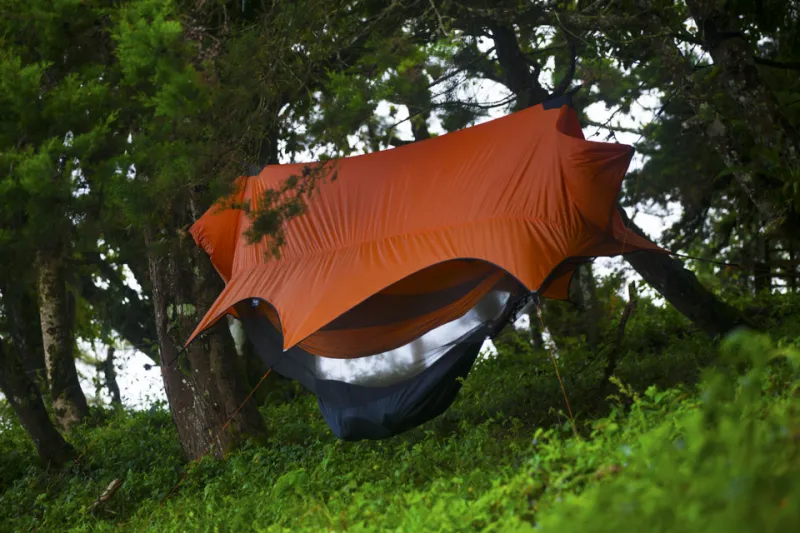
Photo: Best Gear Designs, CC BY-SA 3.0, via Wikimedia Commons
I found a pitch last winter that I still think about. It was in a beech wood on the edge of a chalk escarpment, and it had everything the internet says a wild camp should have: a stone fire ring blackened at the centre, two half-sawn logs arranged as seats, a lean-to frame lashed together from green hazel, a pile of unused kindling and, underneath it all, a flattened patch of woodland so thoroughly trampled that the leaf litter had given up.
Whoever built it clearly loved being out there. They'd also guaranteed that the next person to walk that path would find a reason to complain to the landowner. And the landowner, in my experience, doesn't ring up the bushcraft forum to discuss it. They ring the council, or they put a lock on the gate.
The aesthetic we inherited is the problem
Somewhere along the line, the visual language of British bushcraft got stuck on the frontier camp. Shelters you can see from thirty feet. Furniture. A fire that has to be big enough to be worth photographing. It looks brilliant in a YouTube thumbnail and it is, functionally, a small building project in someone else's wood.
Every element of that camp is a scar. The fire ring sterilises the soil for years. Cut hazel won't regrow from a stump that's been hacked rather than coppiced properly. A flattened clearing changes the ground flora and the drainage. And the visible evidence — the thing itself — is what makes the landowner, the ranger, the farmer or the next walker decide that people like us can't be trusted with access.
We talk about leave no trace as a moral position. In Britain in 2026 it's also a practical one. Access is contested, fragile and granted by goodwill far more often than by statute. Every messy pitch chips away at that goodwill.
What 'invisible' actually means
An invisible campsite isn't a campsite at all. It's a decision not to make one.
In practice, it usually looks like a hammock and tarp between two trees that were already the right distance apart, or a tarp pitched low on trekking poles over ground that was already clear. It means no digging, no cutting, no building, no fire ring, no nails, no paracord strung across a right of way at neck height. It means cooking on a gas stove or a small alcohol burner, and if you want a fire, using a raised tray or a fire blanket so that the ground underneath is unchanged — and honestly, most of the time, deciding not to bother.
It also means dispersal. One small group in one small spot is a night out. Ten people in the same clearing, five weekends in a row, is a camp, and camps get noticed.
The five-minute pitch test
Before you set anything up, run through this. It takes about as long as making a brew.
Look up. Dead branches overhead — the ones still attached — are the single most common cause of serious injury at a wild pitch, and they're invisible in the dark. If a limb is hanging or the crown looks storm-damaged, shift.
Look down. Is the ground already bare, or are you about to kill a patch of bilberry to sleep somewhere? Is there a drainage line running through it? Is the soil compacted, which means it will hold water like a bath? Flat and slightly raised beats flat and low every time.
Look around. Is there a faint path, a fence line, a game trail, a view into a house? Are you on a route someone will walk at seven in the morning?
Ask what you'd have to change. If the answer is anything more than 'nothing', it's the wrong pitch.
Judging in the dark, in winter
Here's the honest bit: most of us are picking a pitch at half four in the afternoon in November, with a headtorch, in the rain. That's when mistakes happen.
The single best upgrade to your winter night out is arriving early enough to see. Failing that, walk the site with a low-power torch rather than a floodlight — you'll see the shape of the ground better and you won't blind yourself to the shadows. Kick the leaf litter aside with a boot and feel the ground beneath: soft and spongy means wet, firm and level means sleep. Listen for water. In a quiet wood you can hear a drainage channel long before you see it.
Trees tell you about the ground too. Sphagnum, rushes and willow scrub mean wet. Bracken and bluebell leaves mean reasonably free-draining, and bluebells mean you must be careful where you put your pegs. Avoid the obvious hollows — frost pools in them and so does water.
Finally, pitch low and small. A tarp set high and wide is a sail in a winter gust; one set low and taut with a bit of breathing room is warm, quiet and easy to pack away in the dark.
Fire is where the argument is really won or lost
I'm not going to pretend bushcraft without fire is the whole of the craft. Firecraft matters. But open fire on the ground is the most damaging thing most of us do, and British woodland soils and dry moorland in a low-rainfall spring are not the place to practice it.
If you want to learn, learn somewhere it's permitted — a campsite that allows fires, a private wood with the owner's blessing. Out in the wild, a stove gets you a hot meal without leaving a mark that outlives your visit.
Where access is uncertain
Scotland's access code is generous and it's generous because people behave. England and Wales are a patchwork: open access land for walking, Dartmoor's permitted areas for camping, everything else by permission.
So ask. A knock on a farm door, a message to an estate office, a note in a bothy book — permission is more available than people assume, and a yes with conditions ('not in the lambing field, park by the gate') is worth more than a silent trespass that ends with a locked gate for everyone.
The morning test
When you leave, stand where you slept and ask whether the next person would know you'd been there. Not the bin man, not the ranger — the next walker, ten minutes behind you. If the answer is yes, you've left something to fix.
That's the whole argument, really. An invisible campsite costs you nothing except the photograph of your own handiwork. It keeps the goodwill, keeps the access and keeps the ground worth coming back to. Bushcraft in Britain doesn't need bigger camps. It needs quieter ones.