Leave the Deadwood Standing: The Case for Carrying Your Own Fuel
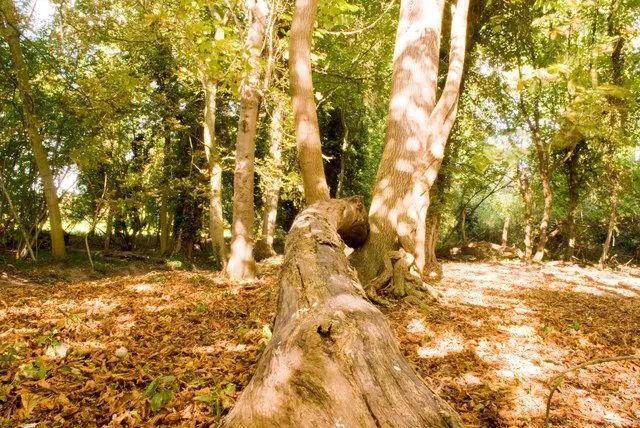
Photo: Martin, CC BY-SA 2.0, via Wikimedia Commons
Almost the first thing anyone learns about making fire in a British wood is that you gather dead wood. Dry twigs from the standing dead, a few thumb-thick branches from the ground, kindling snapped off a fallen bough. It's taught as though the wood were a larder, stocked for the taking.
The trouble is the word 'gather' hides a question: from where? A wood doesn't distinguish between a spruce plantation thinned last winter and a fragment of ancient semi-natural woodland that has been quietly rotting and recycling for four hundred years. The forager's eye sees fuel. The ecologist sees a slow, irreplaceable system.
'Dead' Is Doing a Lot of Work
Dead wood in a wood is not waste awaiting collection. It is, depending on who's counting, somewhere around a third of the woodland's biodiversity, and conservation bodies have been saying so for decades.
Standing dead trees, the ones bushcrafters are often most careful to avoid, are the rarer and more valuable sort. Rotting heartwood feeds beetle larvae that may spend three or four years getting to adulthood, including the stag beetle in the south and its much commoner relatives. Loose bark shelters bats through the winter, barbastelle among them, which is why felling operations near roosts get planned with such care. Splits and hollows take hole-nesting birds, and the ones that don't nest there feed on what does.
On the ground, a fallen branch is a slow-release fertiliser. It holds moisture through a dry August, hosts fungi that break lignin down over years, and gives bryophytes somewhere damp to live. Dismantle the brash piles a forester left and you're taking apart somebody's habitat.
The Arithmetic Nobody Mentions
A thumb-thick stick you snap for a brew took decades to grow and will take years to replace. In a wood with a few hundred visitors a year, one handful each is thousands of handfuls. In popular honeypot woods, paths get stripped bare at the edges, and the small stuff goes first because it's the most convenient.
That's the uncomfortable bit. The impact isn't dramatic. It's cumulative, distributed, and it doesn't look like damage unless you know what a wood is supposed to look like underneath the leaf litter.
The Rules Aren't Uniform, and They All Point One Way
It's worth being straight about the legal position, because the internet isn't. In England and Wales there is no general right to camp on open country and no right to take wood from it. A public footpath gives you a right of way, not a right of harvest. Standing or fallen timber taken without permission can amount to theft; cutting it can be criminal damage. Plans, fungi and uprooted plants carry their own protection under the Wildlife and Countryside Act 1981. Sites designated as SSSIs, national nature reserves or special areas of conservation come with consent regimes and byelaws layered on top, and ancient woodland is on the inventory precisely because so little of it is left.
Scotland is different in tone and not in direction. The right of responsible access under the Land Reform (Scotland) Act 2003 covers access, not consumption. The Scottish Outdoor Access Code is blunt about it: take nothing away.
Where a landowner has given permission, ask what they'd actually like removed. Plenty of working woodlands welcome someone clearing cut and stacked timber after a management operation. Nobody welcomes a visitor raiding the deadwood they deliberately left standing.
Carried-In Fuel Sharpens Everything
Here's the part that gets missed in all this moralising: carrying your own wood makes you better at fire craft, not worse.
When fuel comes out of your pack, you weigh the fire before you build it. A kilo of genuinely dry wood holds roughly four to five kilowatt hours, which is far more than a brew and a one-pot supper require. You stop building bonfires and start building small, hot, efficient cooks: a billy can, a trivet, a bit of foil. You learn that a fire which needs constant nursing was a bad fire from the start, and that most of the failure happens in the tinder and the first two minutes.
A small gas or meths stove for the routine brew is not a cop-out. It's a choice about impact, and it leaves your wood-craft for the occasions when it earns its keep.
Foraging and Fuel Are Different Verbs
Foraging is a considered, permitted, knowledge-led activity, usually involving leaves, fruit or fungi, always with the landowner's blessing. Fuel-gathering is bulk consumption. The two get tangled together in outdoor writing and they shouldn't. A handful of sloes is not the same as a bag of sticks, and 'it's only dead wood' is the phrase that precedes every scarred fire pit in the country.
Restraint Is the Skill, Not the Restriction
Bushcraft is often sold as a set of unlocks: now you can light fire, now you can build shelter, now you can find water. But the thing that separates a competent person from an enthusiastic one is judgement, and judgement is mostly about knowing when not to.
Set yourself rules and keep them. Burn what you carried. One match. If the fuel in the wood is wet, the fire is small and short. If you find yourself eyeing a promising fallen bough, ask who else is using it, and whether the answer is 'nobody' or 'quite a lot, actually, over the next ten years'.
The fire you don't light is the one that leaves the next visitor the same wood you found. That's not a restriction on wild skills. It's the whole point of them.