Suspension, Not Scars: Sleeping Light Between British Trees
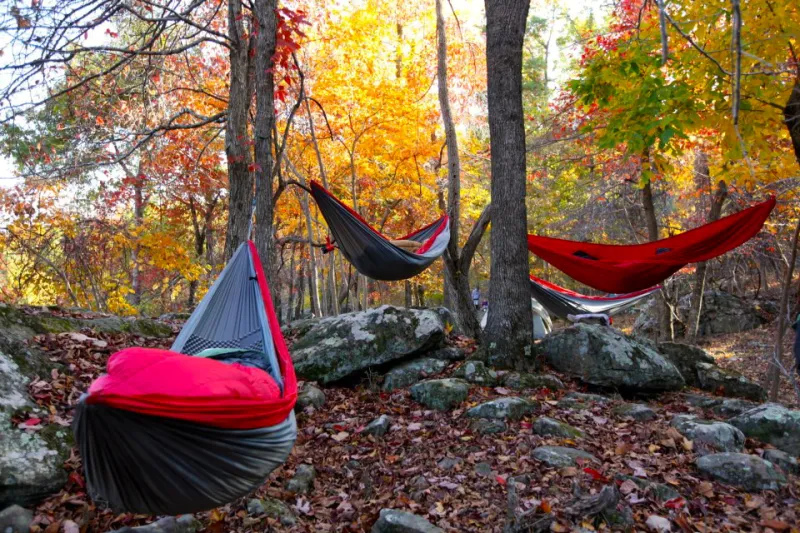
Photo: Best Gear Designs, CC BY-SA 4.0, via Wikimedia Commons
Hammock camping has a way of sounding effortless. Two trees, a bit of fabric, a view of the canopy and a night under the stars. In a British wood, though, the reality is wetter, colder and more complicated than the brochure suggests. The hammock is not simply a tent suspended above the mud. It is a relationship with two living things, and the quality of that relationship is decided long before you climb in.
That is the useful way to think about low-impact hammock camping. Not as a gear list, but as a series of small restraints. Where you hang, how you wrap the trees, what you put underneath you and how you leave the pitch in the morning all matter more than the colour of your tarp.
Begin with the trees, not the catalogue
Before you think about hammocks, tarps or quilts, check that you are allowed to camp there. In England and Wales, wild camping generally needs the landowner's permission, and in Scotland the access rights come with responsibilities. Ancient woodland, SSSIs, nature reserves and land managed for conservation often deserve a wider berth altogether. A hammock is low-impact only when it is in the right place.
Then look at the trees themselves. You want mature, healthy hardwoods with trunks thick enough to take a broad strap without pinching. As a rough guide, look for trees around 30cm across or more. Oak, beech and mature sycamore are often good candidates. Birch and willow have softer bark and deserve more caution. Avoid saplings, dead standing trees, trees with obvious fungal brackets, loose bark, deep cracks or holes that could be bat roosts. Look up as well as across. A hammock will not protect you from a dead branch.
And do not hang across a path, a game trail or a narrow wildlife corridor. You may be asleep, but the wood is still working around you.
The strap is the whole argument
The single most important piece of hammock kit is not the hammock. It is the suspension. Bare cord, thin rope and narrow webbing concentrate load and can cut into bark. Wide tree straps, ideally at least 2.5cm across and better still closer to 4cm, spread that load and reduce the chance of lasting damage. Keep them flat, untwisted and snug rather than winched tight. Ratchet straps belong in a van, not around an oak.
Hang at roughly a 30-degree angle from the tree, with the hammock at about chair height when empty. That gives a comfortable lie and puts less strain on the anchors. Use drip lines on your suspension in wet weather so rain runs down and away rather than into your hammock. And when you leave, loosen the straps gently and inspect the bark. If you can see a groove in the morning, your system was too narrow, too tight or left too long.
No nails, no screws, no carving, no cutting. If a pitch needs modification, it is the wrong pitch.
Pick a pitch that wildlife can ignore
A hammock lets you sleep off the ground, but it does not make you invisible. Choose a spot away from water sources, nest holes, badger setts and obvious animal runs. Keep your footprint small. Do not clear vegetation to make a nicer view, and do not string lights around the clearing. Light and noise travel further through a wood than most people expect.
For cooking, move to a durable surface such as bare rock, gravel or a established fire spot if one exists and is permitted. In most British woods, a small stove is the sensible default. Keep food sealed and stored away from your sleeping area, mostly to discourage rodents and foxes. The aim is not to build a camp. It is to borrow a patch of woodland for a night and give it back in the morning.
Warmth is a bottom-up business
The classic hammock mistake is to climb into a sleeping bag and wonder why your back feels cold by midnight. The bag compresses under you, losing most of its insulation. You need something beneath you that keeps its loft. An underquilt is the proper tool. A wide insulated sleeping mat can work, especially if you can stop it sliding about, but it is a compromise.
British nights are damp as much as cold, so synthetic insulation is forgiving if things get wet. Add a top quilt or sleeping bag, dry base layers and a hat. Avoid cotton next to the skin. Vent the hammock before you get too warm, because condensation is the quiet enemy of a comfortable night. A cold backside at 3am is not a rite of passage. It is a signal that your insulation plan is incomplete.
A tarp is a roof with manners
Your tarp should be pitched with the prevailing wind in mind and high enough to sit up under, but low enough to shed driving rain. In summer, give yourself ventilation and a view. In wind and rain, pitch lower, tighter and with one end angled into the weather. Use soft tie-outs or straps around anchor trees rather than thin cord pulled hard against bark. Reflective guy lines are kinder to anyone moving around camp after dark.
A hammock tarp is not a tent. It is a shelter you can hear. That is part of the appeal, but it also means you need to think about splash, condensation and drips. Small details, like a drip line on the suspension and a dry patch for your boots, make the difference between a character-building night and a genuinely good one.
The morning audit
Before you walk out, do a slow circuit of your pitch. Check the trees for bark damage. Gather every strand of cord, every crumb and every bit of tape. Fluff up compressed ground, replace any leaf litter you moved and leave the deadwood where it lies. The best hammock camp is one that leaves the next visitor guessing whether anyone was there at all.
When a hammock is the wrong answer
If the trees are unsuitable, the permission is unclear or the site is too fragile, use a tent, a bivvy or simply walk on. A hammock is a tool, not a personality. Used well, it is one of the lightest and least damaging ways to spend a night in a British wood. Used badly, it is just another way to leave a mark. The difference is suspension, restraint and a bit of respect for the trees doing the holding.