Good Reason, Good Habit: Carrying a Bushcraft Knife in Britain in 2026
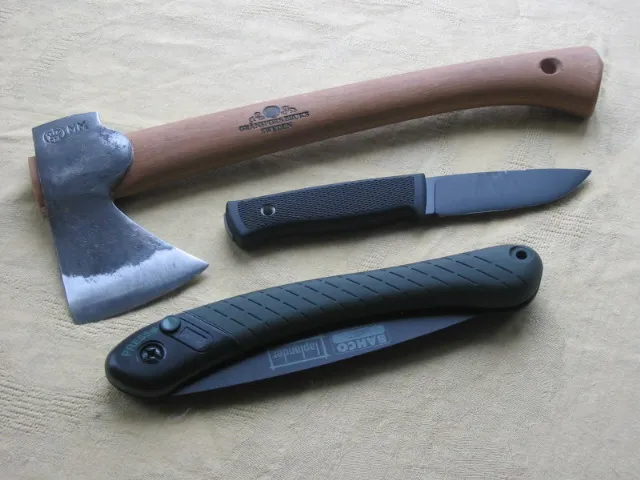
Photo: Great Pink Taco at English Wikipedia, Public domain, via Wikimedia Commons
There is a moment in every bushcraft weekend when the knife comes out. Maybe it is a bit of whittling, maybe it is food, maybe it is a small repair to a strap or a pot hanger. The tool is ordinary. The context is not always as simple. In Britain, a knife is both a practical piece of kit and a subject that can attract attention fast. The trick is not to be timid about woodcraft, but to be obvious about why the blade is there.
This is a practical guide, not legal advice. The law across the UK is not one single rule, and it can change. Check current guidance from GOV.UK, Police Scotland and the PSNI before you travel. What follows is the sensible, low-drama approach that keeps a routine weekend routine.
Start with the law, not the blade
The UK does not have one tidy national knife rule. England and Wales, Scotland and Northern Ireland each have their own framework. The shared principle is simple enough: you should only carry a knife in public when you have a genuine reason that fits the activity you are actually doing. A bushcraft knife is not everyday carry. It is not a fashion accessory. It is not something to keep in your coat because it might come in handy.
That distinction matters. A fixed-blade knife in a sheath belongs in a pack on the way to a campsite, a course, a conservation task or a piece of land where you have permission to be. It does not belong in a supermarket, a pub garden or a town-centre sandwich shop. Keep the tool and the trip connected in your own mind, and the explanation becomes much easier if anyone asks.
The everyday-carry line
In England and Wales, it is an offence to carry a knife in public without good reason or lawful authority. A folding pocket knife with a non-locking blade of three inches or less is generally treated differently from a fixed blade, but that is not a free pass to carry anything anywhere. It can still become a problem if it is used or threatened in a way that makes it an offensive weapon. The small folder is a useful day-walk tool. It is not a licence to stop thinking.
A bushcraft fixed blade sits outside the everyday-carry idea. That does not make it illegal. It means the reason for carrying it has to be real, specific and tied to what you are doing. Travelling to a woodland camp with a rucksack, shelter, cooking kit and a folding saw is a very different picture from carrying the same knife on a night out. Context is everything.
Scotland and Northern Ireland: do not assume
Do not carry England and Wales assumptions north or across the water. Scotland has its own knife laws and a reasonable-excuse approach. The familiar three-inch folding-pocket-knife exemption is not a blanket rule you should rely on there. Northern Ireland also has its own legislation and policing context. If you are travelling, check the current guidance for the nation you are in, not the one you left.
This is especially important for courses and organised events. If you are booked on a bushcraft session, keep the booking confirmation on your phone. If you have written permission from a landowner, keep that too. These are not magic documents, but they help show that the knife is part of a planned activity rather than an aimless piece of steel in a bag.
What good reason actually looks like
Good reason is not a phrase you recite. It is a set of facts. You are travelling directly to or from a campsite where you will use the knife for camp tasks. You are attending a course that requires it. You are doing conservation work with a group. You are on private land with the landowner's permission. Those are the kinds of details that make sense.
What weakens the picture is drift. If you are heading to the woods but stop for a few pints in town with the knife on your belt, you have made a simple trip complicated. If the knife is loose in the passenger seat, or clipped to your trousers on the bus, you have made it look less like kit and more like a statement. Keep the journey direct, keep the tool packed, and keep the story boring.
Transport is part of the craft
A fixed blade should travel in its sheath, inside your rucksack, ideally low down and not immediately accessible. Do not wear it on your belt through a village, a car park or a railway station. In the car, put it in the boot or somewhere secured and out of reach. If you use public transport, check the operator's rules before you travel. Some services are stricter than the law requires, and arguing at a ticket barrier is nobody's idea of a good start to the weekend.
When you arrive, keep the knife sheathed until you are at your pitch or work area. Use it there. If you move between woods, pack it away again. The same goes for a folding saw. It is a brilliant bushcraft tool and often more useful than a knife for gathering fuel, but it still needs to travel like a tool rather than a toy.
Permission is not paperwork
Landowner permission matters twice. It matters for being on the land, and it matters for what you plan to do there. Some sites welcome campers but forbid cutting or carving. Some allow fallen wood collection but not live wood. Some have a no-knife policy for insurance or group reasons. Respect it. If the rules do not fit your plans, find another patch rather than testing the boundary.
A knife is not a licence to harvest whatever you like. Use it for whittling, food, cordage and small camp jobs. Use a folding saw for deadwood where permission allows. Leave standing deadwood alone. The low-impact habit is not just ethical decoration; it also makes your reason for carrying the tool clearer. You are there to do a task, not to perform a survival fantasy.
Choose less steel, learn more
A modest fixed blade and a folding saw will cover most British bushcraft weekends. Add a small non-locking folder for day walks if it suits you. You do not need a locker full of steel. A huge survival knife, a machete or something marketed with more attitude than edge is not a smart carry in the UK, and it is not a better teacher. A sharp, simple tool used well will teach you more about wood, safety and restraint.
Keep the blade clean and sharp. Store it in its sheath. Check local rules before buying anything that looks aggressive. Practise your cuts at home or in the garden before you take the tool into the woods. Confidence comes from competence, not from the size of the blade.
If you are stopped
Stay calm. Be polite. Explain where you are going and why you have the knife. Do not wave it about or reach for it. Do not argue the law at the roadside. If you have a booking, permission or a course email, offer to show it. If an officer gives you advice, take it. The aim is not to win a debate. The aim is to get back to the woods with your kit and your weekend intact.
The point
Responsible confidence is not about being casual with knives. It is about being clear. Carry the tool you need, for the task you are actually doing, and transport it like a piece of camp kit rather than a belt ornament. In 2026, the law still asks for context, and good habits make that context obvious. A small fixed blade, a folding saw, a direct journey and a landowner who knows your name will take you further than a rucksack full of steel ever will.