Where the Ground Gives Way: Crossing Britain's Bogs Without Leaving a Scar
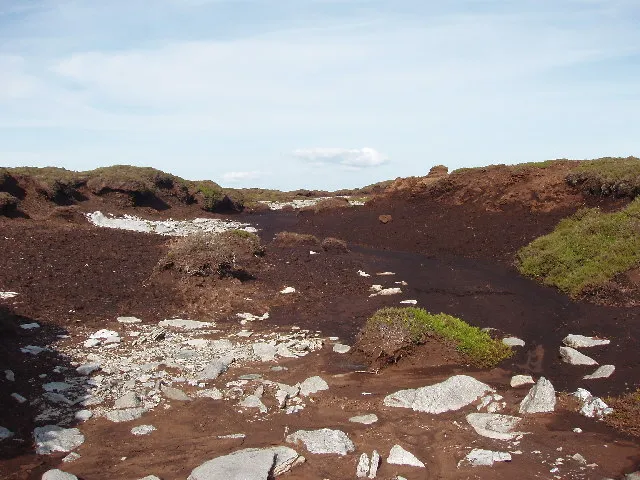
Photo: Iain McDonald, CC BY-SA 2.0, via Wikimedia Commons
There is a particular sound a British bog makes when you get it wrong: a soft, apologetic slurp, then the cold shock of water finding the gap between gaiter and sock. Nothing dramatic. Just a landscape quietly absorbing your bad decision.
Mire, fen, wet heath and blanket bog cover a fair share of these islands. The Flow Country up in Caithness, the peaty tops of the Pennines, the soggy skirts of Dartmoor, the remnants of the East Anglian fens — wet, soft underfoot, and far more interesting than the word 'bog' suggests. They hold carbon, they slow water before it reaches the towns below, and they grow plants you will not find in a garden centre. They also eat boots and, occasionally, plans.
So here is how to move through them: not as an obstacle to be beaten, but as ground worth understanding.
The wettest ground is not wasted ground
Start by dropping the idea that a bog is a broken field waiting to be drained. Peat is thousands of years of compressed plant life and it builds at roughly a millimetre a year. One careless bootprint through a bare peat edge can stay visible for a decade and keep eroding long after you have driven home. That is the whole argument for walking wet ground carefully, in one sentence.
Reading the ground before you commit
Bogs announce themselves if you know the vocabulary.
- Colour. Bright green moss over dark water is a warning. Sphagnum comes in reds, ochres and pale greens and holds water like a sponge, so a carpet of it usually means saturated ground beneath.
- Plants. Cotton grass tufts, cross-leaved heath, bog asphodel, deer grass — all happy in wet ground. A change from heather and bilberry to these species is your cue that the ground is getting softer.
- Texture. Tussocky hummocks of heather and sedge usually sit above the water table. Flat lawns of moss between them usually do not.
- Edges. Peat hags — those raw, stepped banks of exposed peat you see on Kinder and Bleaklow — are unstable by definition. Stay off the lip and never walk along the base of a collapsing edge.
- Groughs. Deep, narrow channels cut into peat, common on the southern Pennine plateaus. They look like paths and they are not. Follow one uphill by accident and you may find yourself in a maze.
A trekking pole or a long stick is worth more than any app out here. Push it in. If it goes in easily and comes out wet, believe it.
Footwork: the art of not dancing
Bad bog technique looks like panic. Legs pumping, weight shifting every half-second, mud flying. Good bog technique looks almost bored.
Keep your weight over your feet and your steps short. Place the foot flat rather than heel-first, so you spread load across the whole sole. On tussocks, step onto the crown, not the slope. Never jump between hummocks — the landing triples the pressure and that is when you go through.
Where a line of dry-ish ground already exists, use it. Moorland paths are often braided webs of trods, and every new line through the moss widens the erosion. Walking two abreast on soft ground doubles the damage; walk in single file and let the ground recover behind you.
If you do go in, do not thrash. Get your poles or stick across solid ground, lean forward, and crawl out rather than trying to haul yourself vertically. If a companion is stuck, they should not grab you — you will both go in. Throw them a line, a pole, or your pack strap and keep your own weight low and back.
What belongs on your feet
Two schools exist, and both are right in the right place.
Sealed boots — leather or lined synthetic with a waterproof membrane — keep water out until it comes over the top. Superb for short crossings and cold days. Once they flood, though, they stay flooded, and wet boots in a cold wind are how people get into trouble.
Fast-draining boots and shoes let water straight through and straight out. Uncomfortable in theory, forgiving in practice, and much better on a long wet crossing where water is going to get in regardless of what you spent.
Either way: gaiters, wool socks, and a dry pair kept in a plastic bag for the bothy, the car or the tent. Wellington boots are fine for a kilometre of wet field; over ten miles of moor they will shred your calves and give you no ankle support.
Route choice, and the shortcut that costs the moor
The straight line is almost never the low-impact line. A dry ridge, a sheep track along a contour, a line of old flagstones — all of these beat a bearing across the middle of a mire, even if they add half a mile.
Plan your crossings for the drier months, or for a run of dry weather, and be willing to change the plan. If a shortcut saves you twenty minutes and carves a fresh channel through bare peat, it is not a shortcut. It is a small permanent change to a landscape that took millennia to build.
Access land under the Countryside and Rights of Way Act lets you roam widely in England and Wales; Scotland's right to roam is broader still. Freedom to walk does not remove the obligation to walk lightly, and on peat that obligation is at its sharpest.
What to leave behind
No cairns. No cut turfs for a seat. No pulling sphagnum for tinder, however tempting — take your own. Pack out everything, including the tea-bag that blew under a heather clump.
If you want to give something back, the practical route is volunteering: peatland restoration days with bodies like the National Trust, Moors for the Future or your local wildlife trust involve more spade work than Instagram, and they will teach you more about wet ground in a morning than a year of reading.
Bogs are not the boring bits between the summits. They are the reason the summits have water in them. Walk them slowly, walk them in single file, and leave them exactly as wet as you found them.